...

Blog

Home Blog

Where to Buy Large Outdoor Ceramic Flower Pots in China?

China offers a wide range of large outdoor ceramic flower pots, from hand-finished stoneware to high-fired planters for patios and commercial landscapes. But choosing a supplier takes more than comparing photographs. Buyers should check pot dimensions, wall thickness, drainage holes, glaze consistency, and how each item is packed for shipping. Small details matter. A thick rim can help resist everyday knocks, while a drainage hole can prevent water from pooling around roots.

Industry data needs careful reading. Grand View Research’s Gardening Equipment Market analysis tracks broader gardening demand, not ceramic planters alone, so it can provide context but not a direct sales forecast for this product. UN Comtrade records ceramic goods within broad trade classifications; those categories do not cleanly separate large outdoor flowerpots. The data is imperfect. That distinction matters when comparing supplier claims with market figures.

This guide explains where to buy ceramic flower pots large outdoor in China and how to assess manufacturers, trading companies, and sourcing platforms. Ask for recent production photos, sample measurements, glaze specifications, and packaging details. For heavier pots, request a clear shipping quote that states whether the price covers inland transport, export packing, and port charges. A sample may look excellent, yet the delivered batch can vary. Check before committing to a large order.
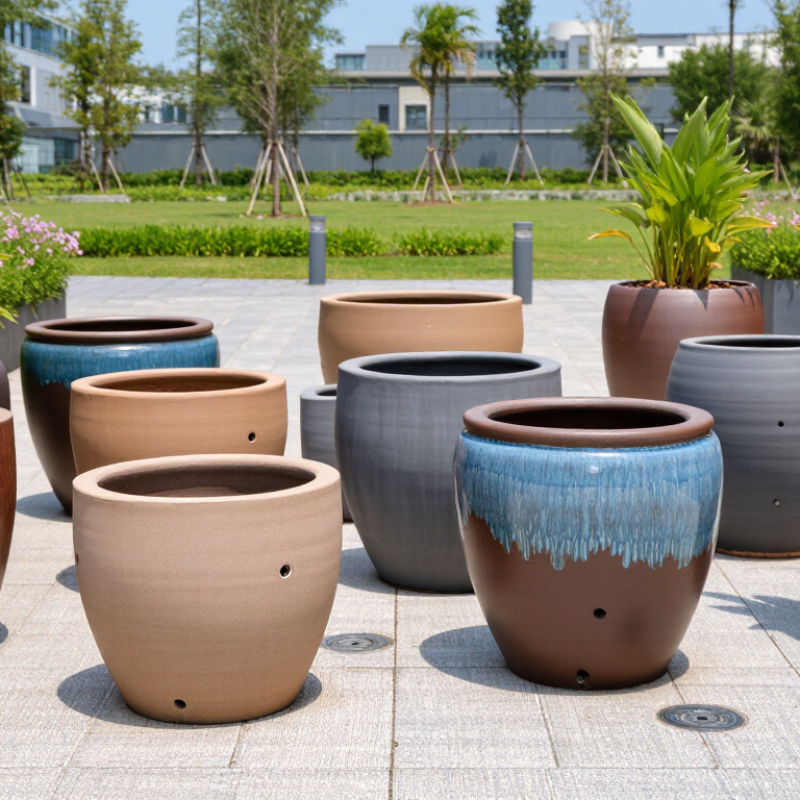
Where to Buy Large Outdoor Ceramic Flower Pots in China?

Defining the Requirements for Large Outdoor Ceramic Flower Pots

Defining requirements starts with the planting site, not the pot’s appearance. Measure the root ball, finished plant height, doorway, and delivery route. Allow room for growth, but check the usable interior width; listed dimensions often describe the outside. Measure twice. For a windy terrace, favor a broad base and a lower center of gravity. On a balcony, confirm the floor’s load capacity before ordering. The U.S. Geological Survey gives water’s weight as about 8.34 pounds per U.S. gallon.

That is roughly 83 pounds for ten gallons, before adding the ceramic body, wet soil, or plant.

Drainage matters. Specify unobstructed drainage holes and ask how the maker manages water absorption and firing consistency. For freeze-prone locations, request documented freeze-thaw testing; “outdoor use” alone is vague. Check the NOAA 1991–2020 U.S. Climate Normals for local temperatures and precipitation, then match the pot’s stated performance to those conditions.

Ask suppliers for actual dimensions, empty weight, packaging details, and test documentation. A detail I would recheck is the opening diameter: a pot may look generous outside yet restrict the root ball inside. Compare samples or drawings before confirming a large order.

Exploring Wholesale Markets and Online Sourcing Platforms in China

Where to Buy Large Outdoor Ceramic Flower Pots in China?

Wholesale Markets and Online Sourcing Platforms in China

China offers two useful sourcing routes: regional wholesale markets and online supplier directories. In person, compare pot thickness, drainage holes, glaze consistency, and packaging at several stalls. Ask whether the quoted price includes export cartons and whether mixed sizes are available. Online, request close-up photos, dimensions, weight, minimum order quantities, and a sample before discussing bulk production. China’s National Bureau of Statistics reported online retail sales of 15.43 trillion yuan in 2023, with physical goods accounting for 27.6% of total retail sales. This broad figure signals a substantial online buying channel, but it is not specific to flower pots.

For large planters, shipping protection matters as much as the finish. Ask suppliers to test-pack one pot and share carton measurements; a tall pot can look sturdy yet crack at the rim during transit. Compare quotes on the same specifications, including glaze, drainage, and packaging. A polished listing is not proof of consistent production. Supplier checks take time, and one sample may not reveal every flaw.

Tips: Confirm measurements in writing, inspect a sample, and clarify breakage procedures before paying a deposit. Keep the questions specific.

Identifying China’s Major Ceramic Production Regions

China’s ceramic production is regional, with different areas specializing in distinct clay bodies, finishes, and firing traditions. For large outdoor flower pots, Guangdong is worth exploring. Chaozhou and Foshan have broad ceramic manufacturing networks, including producers offering planters in varied sizes and glazes. Buyers may be able to compare several workshops during one sourcing trip. Still, some makers focus more on decorative finish than thick, weather-ready walls.

Jingdezhen in Jiangxi is known for porcelain expertise and design-led work, while Yixing in Jiangsu is associated with distinctive clay ware. These strengths do not mean every supplier makes oversized garden pots. Ask about kiln dimensions, firing temperatures, wall thickness, and packing methods. Check the base. A large pot may look sound but crack around its drainage hole after repeated wet-dry cycles.

Fujian’s Dehua and other southeastern production areas may also offer decorative ceramic work, though ranges vary by factory. Request a sample close to your target diameter, then inspect its foot ring, drainage opening, and glaze consistency. For exposed gardens, ask whether the pot has been tested for your local winter conditions; “outdoor” can mean different things. Regional reputation is a useful starting point, not a substitute for checking the workshop’s capacity and quality controls yourself.

Evaluating Suppliers, Product Quality, and Customization Options

When evaluating suppliers of large outdoor ceramic flower pots in China, look beyond catalog photos. Ask for a fired sample, current production images, and written specifications for dimensions, wall thickness, drainage holes, and glaze. A pot should sit evenly on a flat surface, with no hairline cracks or blocked drainage. Small details matter. If pots will face freezing winters, confirm the clay and finish have been tested for those conditions; “outdoor use” alone is vague.

Check whether the supplier explains kiln variation, inspection steps, packaging, and realistic lead times. Request measurements and clear photos from a production batch, not only a showroom sample. A sample may look excellent yet vary after mass firing; that uncertainty deserves agreed tolerances in writing. For customization, share a drawing with dimensions, base shape, drainage placement, and finish references. Confirm color with a physical glaze sample, since screens can mislead. Ask about prototype cost, minimum order quantities, and how changes affect delivery. I would not assume every detail can be reproduced perfectly. Set acceptance criteria before production, and keep the approved sample for comparison.

Planning Orders, Shipping, and Import Logistics

Where to Buy Large Outdoor Ceramic Flower Pots in China?

When comparing Chinese suppliers, request exact rim diameter, height, weight, and carton dimensions. A pot that looks compact in a photograph can consume substantial container space. Ask for recent production photos and a sample packed like the order, not just an unboxed sample. Check the base, drainage hole, and glaze for chips or uneven firing. Small details matter. Confirm lead time, order quantity, packaging method, and whether the quotation includes inland transport to the port. UNCTAD’s Review of Maritime Transport 2024 reports that maritime shipping carries over 80% of world trade by volume, so port schedules and freight conditions can affect delivery plans.

For large pots, compare less-than-container-load and full-container options using the shipment’s cubic volume, weight, and breakage risk. Reinforced cartons, dividers, and pallet protection add cost, but one cracked pot can erase apparent savings. Ask the supplier to share packing dimensions before booking freight. A weak point in many plans is assuming the quoted delivery time includes customs clearance. It may not. Prepare a commercial invoice, packing list, and bill of lading, and confirm the correct tariff classification and import charges with a customs broker in your destination country. The World Bank’s Logistics Performance Index 2023 evaluates customs, infrastructure, and shipment timeliness; these factors are worth checking when comparing routes and forwarders. Allow a buffer. Shipping estimates can shift.

Need Packaging Solutions?

Get Free Estimate!

1-800-493-7441
Contact Us