When people ask, “What are 4x3 Thermal Labels used for?” the practical answer begins with the workflow. These labels commonly identify shipping cartons, retail products, warehouse bins, inventory shelves, and customer orders. Their three-by-four-inch format offers enough space for a barcode, product name, quantity, date, and handling note. A warehouse worker can scan one quickly under ordinary lighting. A shop employee can read it without moving the package.
Label-industry consultant Mike Fairley has described the label as “the silent salesperson.” That idea also applies to logistics. A 4x3 thermal label silently communicates where an item belongs, what it contains, and how it should move. Direct thermal versions work well for short-term shipping and receipt applications. Thermal-transfer versions are often better when labels face heat, friction, moisture, or longer storage. Printer compatibility matters. So does the adhesive.
Small details decide success. A glossy carton may reject a weak adhesive. A poorly sized barcode may scan only after several attempts. That wastes time. It can also create avoidable inventory errors. In practice, businesses should test the label material, printer settings, ribbon, and scanner together. One overlooked variable can weaken an otherwise efficient system.
Not every 4x3 thermal labels application needs the same construction. That is where simple buying guides can become misleading. A shipping label, freezer label, and shelf label may share one size, yet require different faces and adhesives. The best choice comes from observing the real environment, not relying on dimensions alone.
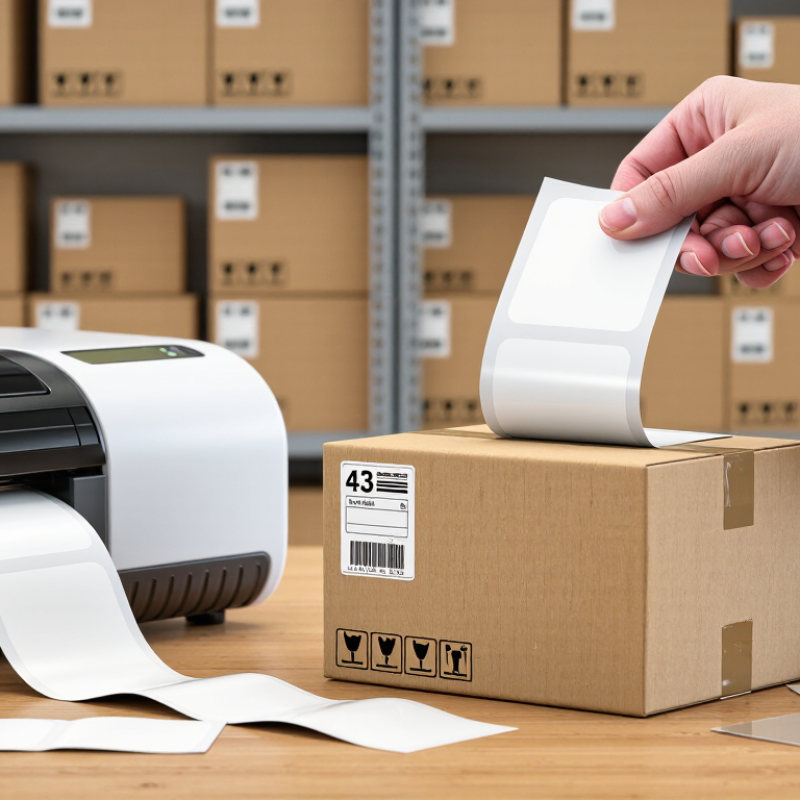
What Are 4x3 Thermal Labels Used For?
4×3 thermal labels are common in parcel shipping, inventory control, product identification, and warehouse picking. Their 4-inch width and 3-inch height provide room for barcodes, tracking numbers, addresses, and handling notes. The Pitney Bowes Parcel Shipping Index reported 161.8 billion parcels worldwide in 2022. That volume explains why fast, readable labels matter in busy fulfillment areas.
Direct-thermal printing creates images through heat-sensitive material, so it does not require ink or a ribbon. This design reduces consumables and supports quick replacement during peak workloads. A 203 DPI printer is often suitable for standard shipping barcodes and text. A 300 DPI model can produce sharper small characters, dense symbols, and detailed graphics. However, higher resolution does not automatically improve scanning. Poor contrast, moisture, heat, or incorrect label settings can still cause failures. That part is easy to overlook.
Tips: Test the actual 4×3 label with your scanner, software, and printer speed. Leave clear space around barcodes. Store unused labels away from heat and sunlight. Industry guidance from GS1 emphasizes consistent barcode dimensions and quiet zones. In practice, operators sometimes choose 300 DPI when 203 DPI would work, increasing costs without a clear benefit. I would review failed scans weekly, because a perfect-looking label is not always a reliable one.
| Data Dimension | Typical Specification | Practical Meaning | Common Uses | Printing Considerations |
|---|---|---|---|---|
| Label Size | 4 × 3 inches Approx. 101.6 × 76.2 mm | A rectangular label with a four-inch width and a three-inch height when used in landscape orientation. | Shipping information, product identification, inventory control, storage locations, and carton contents. | Confirm whether the printer feeds the label in portrait or landscape orientation before creating the label template. |
| Printable Area | Usually slightly smaller than the physical label | Margins, gaps, printer calibration, and the label’s liner may reduce the usable area. | Addresses, barcodes, item descriptions, quantities, dates, and handling instructions. | Keep essential text and barcode elements inside a safe margin, commonly about 0.125 inch or more where supported. |
| Printing Method | Direct Thermal | The printhead applies heat directly to heat-sensitive material, creating the image without ink, toner, or a separate ribbon. | Short-term shipping labels, receipts, route labels, warehouse labels, tickets, and temporary identification labels. | Use compatible direct-thermal stock. Exposure to heat, sunlight, friction, or chemicals can cause fading or darkening over time. |
| 203 DPI Resolution | About 8 dots per mm Approximately 812 printable dots across 4 inches | A standard resolution suitable for most text, basic graphics, and common linear barcodes. | Shipping labels, warehouse bin labels, order labels, and general-purpose logistics printing. | Works well with normal font sizes and appropriately sized barcodes. Very small text and fine graphics may lose detail. |
| 300 DPI Resolution | About 12 dots per mm Approximately 1,200 printable dots across 4 inches | Produces finer detail than 203 DPI at the same physical label size. | Small product labels, detailed compliance information, compact two-dimensional codes, and labels requiring sharper text. | Requires artwork and printer settings designed for 300 DPI. Increasing resolution does not automatically improve a low-quality source image. |
| Text Capacity | Depends on font size, margins, orientation, and layout | The 4×3-inch format provides more space than small retail stickers while remaining compact for packages and containers. | Product names, stock numbers, quantities, dates, locations, instructions, and shipment references. | Use clear contrast and adequate line spacing. Avoid placing dense text too close to the label edges. |
| Barcode Compatibility | Linear and two-dimensional barcodes, subject to size and contrast requirements | The label can accommodate one or more machine-readable codes when the code is printed at an appropriate size. | Inventory tracking, package identification, order processing, asset tracking, and point-of-use scanning. | Use a quiet zone around the barcode, sufficient bar width, strong contrast, and a verification scan after printing. |
| Material Selection | Direct-thermal paper or synthetic direct-thermal stock | Paper is economical for ordinary indoor use; synthetic stock can provide improved resistance to moisture and tearing. | Paper for routine logistics; synthetic materials for cold storage, damp areas, or more demanding handling conditions. | Choose stock based on expected temperature, moisture, abrasion, storage duration, and surface requirements. |
| Recommended Service Life | Short-term to moderate-term, depending on material and environment | Direct-thermal labels are generally intended for applications where long-term image permanence is not the primary requirement. | Parcel movement, temporary shelf identification, event tickets, dispatch labels, and routine warehouse operations. | For prolonged outdoor exposure, high heat, chemical contact, or archival use, evaluate a more durable label material and printing method. |
| Printer Setup | Correct media size, print speed, darkness, and sensor calibration | Accurate settings help prevent misalignment, blank labels, streaking, and poor barcode readability. | Any workflow requiring repeatable label placement and consistent machine-readable output. | Run a calibration after changing label stock or dimensions, and test the first printed label before starting a large batch. |
Get Free Estimate!