Who Are the Top Produce Packaging Manufacturers in China?
China’s produce packaging manufacturers serve farms, exporters, supermarkets, and fresh-cut processors. Their work is visible in a crate of leafy greens, a ventilated carton of oranges, or a film-wrapped tray of berries. The right package can reduce bruising, manage moisture, and keep products easier to handle. The wrong one can add cost without solving the real problem.
Food-packaging scholar Dr. Gordon L. Robertson’s work points to a practical principle, paraphrased here: “Packaging should protect food quality throughout handling and distribution.” That sounds simple. It is not. A package designed for a short trip to a nearby market may fail during a long export journey. Buyers should compare material quality, ventilation, sealing options, printing, customization, and production consistency. They should also ask how a supplier tests performance, handles changing order volumes, and responds when a sample does not match the final shipment.
This guide examines leading produce packaging manufacturers in China and the capabilities they offer. It considers product range, manufacturing experience, export support, and communication—not just attractive catalog photos. Some suppliers may excel at molded-pulp trays; others focus on corrugated cartons, flexible films, or reusable crates. No single factory fits every crop or route. Details matter: a small vent pattern, a damp warehouse, or a late design change can alter results. And a polished website is not proof of dependable production. Verify samples and specifications before choosing a long-term partner.
What Defines a Produce Packaging Manufacturer in China?
A produce packaging manufacturer in China turns packaging requirements into physical products, from material selection and printing to cutting, forming, and quality checks. For fresh fruit and vegetables, design must account for weight, airflow, moisture, and transport conditions. A ventilated carton, for example, can help air circulate around stacked produce, while reinforced corners reduce crushing during handling. Details matter.
A reliable manufacturer can explain its production process, inspect samples, and provide clear specifications for dimensions, material thickness, and load capacity. Ask whether the company operates its own factory or works through outside suppliers. Then compare sample quality with the written specification. A polished sample alone proves little.
Tips: Request a sample made to your intended size. Check seams, vents, and stacking strength. Ask how defects are recorded and corrected.
Practical experience shows that packaging needs can change between harvest, storage, and delivery. Share the produce type, expected weight, and handling route before production begins. If possible, test filled packages under realistic stacking and cooling conditions. No supplier gets every detail right on the first try; clear feedback and documented adjustments help prevent repeated issues. A dependable manufacturer should answer technical questions directly and make changes traceable.
How Are China’s Leading Manufacturers Evaluated?
Evaluating China’s leading produce packaging manufacturers takes more than comparing prices or polished catalogs. Start with the package itself: inspect wall thickness, seal consistency, vent placement, and how a loaded tray stacks after handling. Small defects matter. A lid that shifts during a short test may perform worse after repeated transport.
Ask for current food-contact material documents, test reports, and batch traceability records relevant to the intended product and market. Reliable suppliers should explain material choices, quality checks, and corrective actions clearly. Verify capacity through production records and, where practical, a site visit or monitored trial order. Test samples with actual produce, since moisture, weight, and cooling conditions affect performance.
Compare delivery consistency, tooling lead times, customization support, and response speed when specifications change. Sustainability claims need evidence too: request material composition and recycling guidance, rather than relying on labels alone. I would use a weighted scorecard, but not treat it as truth. Some criteria are hard to measure, and a supplier may look strong on paper while communication falters under pressure. Check references and repeat a small order before making a long-term decision.
Which Companies Lead China’s Produce Packaging Industry?
China’s produce-packaging leaders are best judged by performance, not publicity.
In practice, the strongest suppliers include regional corrugated-carton makers, molded-pulp specialists, reusable-crate producers, and flexible-packaging converters. Their advantage is matching a package to the crop: vented cartons for leafy greens, firm trays for berries, and stackable crates for repeated cold-room handling.
Small details matter. Poorly placed vents can trap heat.
FAO’s 2019 State of Food and Agriculture estimated that about 14% of food is lost between harvest and retail worldwide. This makes protection during storage and transport a practical measure, not just a design feature. The World Packaging Organisation’s Global Packaging Trends report also highlights material efficiency and sustainability as industry priorities.
For Chinese suppliers, leadership therefore depends on balancing cushioning, airflow, moisture control, and recyclability without making packs unnecessarily heavy.
Buyers should compare test results under real distribution conditions: loaded-carton compression, cooling time, and damage after transit. A neat sample is not enough. Regional production capacity and reliable delivery also matter during harvest peaks.
The comparison is imperfect; public rankings rarely separate produce-packaging specialists from broader packaging manufacturers. Still, suppliers that can show crop-specific trials and consistent quality have the clearest claim to leadership.
What Packaging Solutions Do These Manufacturers Offer?
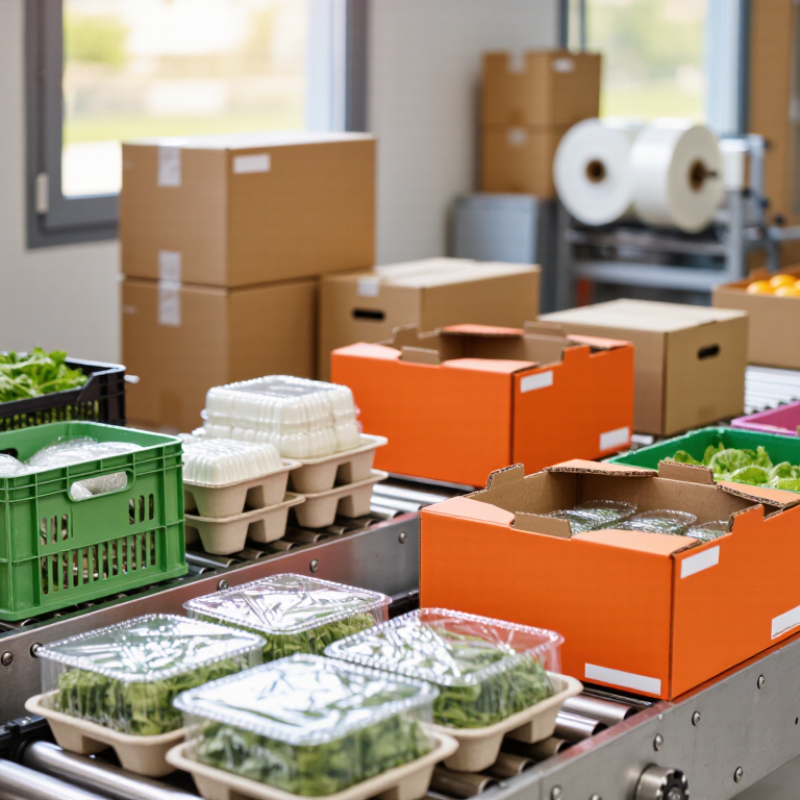
Produce packaging manufacturers in China commonly offer corrugated cartons, plastic crates, molded-pulp trays, and flexible films. These formats serve different crops and shipping conditions. A ventilated carton can help release field heat, while corner supports protect delicate fruit during stacking. Small openings matter. Too many can reduce box strength.
For berries and cut vegetables, suppliers may provide clear clamshells, lidded trays, or breathable film. Some films regulate moisture and gas exchange, but performance depends on the crop, temperature, and storage time. For apples or citrus, mesh bags and sturdy cartons make handling easier and let buyers inspect the produce. Custom printing, carton dimensions, and dividers are also common options. Specifications should be checked against actual product size, not just a sample drawing.
Practical manufacturers can help test packaging with filled samples, including stack tests and cold-room checks. Watch for condensation after a carton moves from refrigeration to a warmer loading area. A vent pattern may improve airflow but weaken a corner; there is no perfect design. Even careful testing can miss rough handling on a real route. Ask for material details and trial results before placing a large order.
How Can Buyers Compare Chinese Produce Packaging Suppliers?
When comparing Chinese produce packaging suppliers, start with the crop and route, not the catalogue. A ventilated crate for leafy greens faces different demands from a corrugated box carrying apples over a long sea journey. Ask for material specifications, load limits, ventilation details, and test results for compression and moisture. Request samples in the intended size, then pack and stack them as they would travel. A clean sample is not proof of consistent production. Ask for batch records and a clear process for handling defects.
There is a practical reason to check performance closely. FAO’s The State of Food and Agriculture 2023 estimated that 13.2% of food was lost between harvest and retail worldwide in 2021. Packaging is only one factor, but poor fit, weak stacking strength, or blocked airflow can add avoidable risk. Ask suppliers to explain how their designs protect the specific produce and route. Ask for independent food-contact test documentation relevant to the destination market, plus details on recycled content and end-of-life options. Compare landed cost, not just unit price, including tooling, freight, lead time, and minimum order quantities. Ask for proof. A small pilot shipment can reveal problems that a factory visit may miss. It takes time, but skipping it can be a costly guess.
How to Compare Chinese Produce Packaging Suppliers
Example buyer-assigned evaluation weights for comparing suppliers. These are planning guidelines, not survey results or ratings of specific companies.
Prioritize food-contact compliance and product protection, then compare customization, production capacity, lead time, minimum order flexibility, and sustainability documentation. Adjust the weights to fit your produce, shipping route, and cold-chain requirements.