...

Blog

Home Blog

Top Custard Jelly Manufacturers for Global Buyers in 2026

Global buyers choosing Custard Jelly manufacturers in 2026 need more than an attractive catalog. They need products that arrive with consistent texture, clear specifications, and dependable documentation. A cup that holds its shape on a warm loading dock matters as much as one that tastes smooth after chilling. Small differences count.

W. Edwards Deming, a quality-management expert, is widely associated with the principle, “Quality is everyone’s responsibility.” Applied to Custard Jelly, that means checking how suppliers manage ingredients, production controls, packaging, and batch records—not judging a sample alone. Ask for product specifications, allergen information, shelf-life details, and export documents relevant to your destination market. Then compare samples under realistic conditions: storage, transport, and serving temperature. A glossy sample can still hide inconsistent batches.

This guide examines manufacturers through practical buyer criteria, including product range, customization, production capacity, quality systems, and communication. It also considers the details that are easy to overlook, such as cup seals, case dimensions, and how quickly a supplier answers a technical question. No checklist guarantees a perfect partnership. Supplier claims still need verification, and a low price may come with trade-offs. That is worth admitting. The best choice depends on your market, target customer, and operating needs. The following overview offers a grounded starting point for comparing Custard Jelly suppliers in 2026.
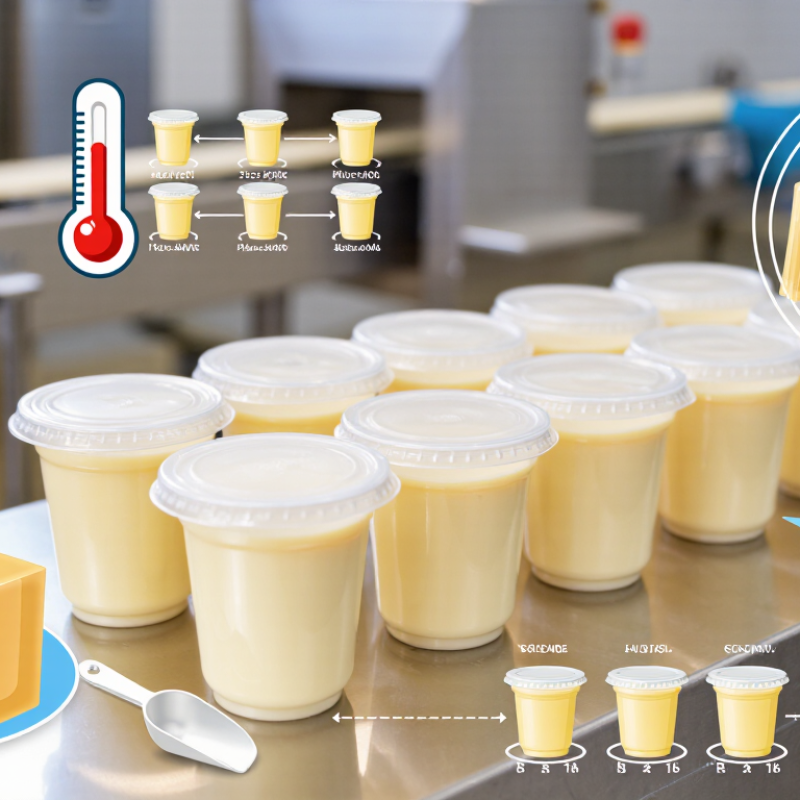
Top Custard Jelly Manufacturers for Global Buyers in 2026

Defining Custard Jelly Products, Formats, and Global Manufacturing Scope

Custard jelly describes a spoonable dessert with a custard-style flavor and a softly set texture. Its recipe may include milk, sugar, starch, and setting agents, but formulations vary by market and product type. Some versions are dairy-based; others use plant-based ingredients. The name alone does not confirm the recipe. Buyers should check ingredient lists and technical specifications.

Formats shape how manufacturers produce and ship the dessert. Single-serve cups suit retail shelves and lunch packs, while larger tubs support food service. Flexible pouches can reduce packaging weight, though they need suitable filling and sealing controls. Ambient products require different processing and packaging choices from chilled desserts. Texture matters. A firm gel may travel well but feel less creamy, while a softer set can be more delicate in transit.

For global sourcing, compare more than the product sample. Ask about batch consistency, ingredient traceability, allergen controls, shelf-life testing, and packaging performance under expected shipping conditions. Request specifications for serving size, storage, and temperature range. Manufacturing capacity also depends on filling lines, packaging materials, and the supplier’s ability to manage different formats. A polished sample is useful, but it cannot reveal every production challenge. Small differences in setting strength may appear only after storage, so independent testing and clear acceptance criteria help buyers assess fit.

Mapping 2026 Manufacturers by Region, Capacity, and Export Readiness

A useful 2026 supplier map should compare regions without assuming that one area leads in every measure. Production clusters across Asia, Europe, and the Americas may offer different strengths in ingredients, packaging, and shipping access. The key question is whether a plant can make the required custard jelly consistently, not simply whether its catalogue looks broad. Ask for evidence.

Capacity figures need careful reading. A stated annual output may reflect theoretical line speed, while practical capacity can change with product size, changeovers, and seasonal demand. Request recent production ranges, minimum order quantities, and realistic lead times. If possible, compare these with a sample schedule for your own pack format. Numbers alone can mislead.

Export readiness is equally concrete. Check whether the manufacturer can provide batch traceability, ingredient and allergen information, shelf-life data, and packaging specifications in clear, usable files. Confirm experience with your destination market and the shipping conditions your product will face. A sealed sample can reveal texture changes after transit, but it cannot replace documented testing. One gap remains: public capacity data is rarely standardized, so buyers should verify figures directly and record what each supplier means by “available capacity.”

Screening Food Safety Systems: HACCP, ISO 22000, and FSSC 22000

For global buyers, food safety documents deserve close review when comparing custard jelly manufacturers. HACCP identifies hazards and sets controls at critical steps, such as heating, filling, and cooling. Ask how staff verify temperatures and record corrective actions. A neat certificate is useful, but it cannot show what happened on a busy production shift.

ISO 22000 evaluates a food safety management system, while FSSC 22000 adds scheme-specific requirements and independent certification. Check that the certificate is current and covers the actual factory, product category, and production activities. Confirm the certifying body and request recent audit findings, not just a scanned certificate. Details matter.

Tips: Ask for a recent batch traceability exercise. Could the manufacturer link a finished cup to its ingredient lots, production records, and dispatch date? Review allergen controls, seal checks, and storage conditions too. If jelly needs refrigeration, compare recorded temperatures with the stated handling instructions. Small gaps count. A supplier may have strong paperwork yet weak day-to-day habits; one visit or video walkthrough can reveal practical issues, though it is not a substitute for an audit.

Applying the EU RTE Listeria Criterion: ≤100 CFU/g Through Shelf Life

For global buyers assessing custard jelly in 2026, the EU ready-to-eat Listeria criterion needs attention beyond factory release. Where a product supports Listeria monocytogenes growth, the limit is ≤100 CFU/g throughout its shelf life when the producer can demonstrate compliance. A low count on packing day is not enough. Buyers should request shelf-life validation covering the product’s actual recipe, packaging, and storage conditions.

Evidence may include representative batch testing, growth studies, and documented temperature assumptions. Check that samples reflect the jelly’s full shelf life, including the final day, and that results come from a competent laboratory. Review pH, water activity, preservatives, and cold-chain instructions together; none proves safety alone. Distribution temperatures can drift. A neat spreadsheet may miss that reality. From 1 July 2026, where the producer cannot demonstrate the 100 CFU/g limit throughout shelf life for applicable products, the EU criterion requires absence in 25 g throughout shelf life.

Tips: Ask suppliers for the validation report, sampling plan, and corrective-action records. Confirm the product category and applicable criterion with a qualified food-safety specialist. Then compare stated storage conditions with your own logistics.

Top Custard Jelly Manufacturers for Global Buyers in 2026 — Applying the EU RTE Listeria Criterion: ≤100 CFU/g Through Shelf Life
Supplier evaluation area What buyers should verify Relevant requirement or benchmark Evidence to request
Product classification Confirm whether the custard jelly is ready-to-eat and whether its formulation and storage conditions can support the growth of Listeria monocytogenes. Classification depends on the product’s characteristics, process, packaging, storage and intended use; it should not be assumed from the product name alone. Product specification, intended-use statement, formulation, pH and water-activity data, and documented rationale for the classification.
Applicable EU Listeria criterion For RTE foods that support growth, establish how the producer demonstrates compliance throughout the product’s shelf life. Under Commission Regulation (EC) No 2073/2005, the relevant criterion is ≤100 CFU/g during shelf life where the producer can demonstrate that this limit will not be exceeded. Product-specific shelf-life study, supporting validation, routine verification results and documented corrective-action procedures.
Criterion where compliance cannot be demonstrated Check the applicable sampling stage and criterion when the producer cannot demonstrate that the level will remain within the 100 CFU/g limit. From 1 July 2026, Commission Regulation (EU) 2024/2895 requires absence in 25 g throughout shelf life for the relevant RTE foods that support growth when the producer cannot demonstrate compliance with the 100 CFU/g limit. Updated hazard analysis, sampling plan, test reports and evidence that the controls address the criterion applicable on the production and placing-on-market dates.
Sampling plan for the 100 CFU/g criterion Review whether the sampling plan and results match the applicable food-category criterion and sampling stage. The relevant EU sampling plan is n = 5, c = 0, m = 100 CFU/g: five sample units, with no unit permitted to exceed 100 CFU/g. Laboratory reports identifying sample units, analytical method, test date, sampling point and results in CFU/g.
Shelf-life substantiation Confirm that the validated shelf life covers the product’s actual recipe, packaging, storage conditions and distribution conditions. The ≤100 CFU/g criterion, where applicable, is a limit to be met through shelf life—not merely at manufacture. Study protocol and results, storage-temperature conditions, packaging details, product-batch traceability and any supporting predictive or challenge-study data.
Hygienic production controls Assess controls for post-process contamination, particularly where the product is exposed after heat treatment and before sealing. EU food-hygiene rules require food business operators to implement procedures based on HACCP principles and appropriate hygiene controls. Process-flow diagram, HACCP-based food-safety plan, sanitation records, environmental-monitoring program and investigation records for positive findings.
Laboratory testing Check that testing is performed by a competent laboratory using a method appropriate to the criterion and product matrix. EU microbiological criteria specify reference analytical methods; validated alternative methods may be used where permitted and properly validated. Laboratory accreditation scope, method reference, method-validation details where relevant, and original signed test reports.
Traceability and recall readiness Verify that each finished-product lot can be linked to ingredients, production records, test results and customers. EU food law requires traceability and action when food is identified as unsafe; operators must be able to support withdrawal or recall when necessary. Lot-coding example, traceability procedure, mock-recall results and documented escalation contacts.
Export and import documentation Confirm destination-market requirements separately from the EU microbiological criterion, including any product-specific import or labeling rules. Requirements can vary by destination and product category; the EU criterion alone does not establish compliance with every importing market. Current destination-market specification, ingredient and allergen declarations, certificate requirements where applicable, and approved label artwork.
Buyer note: This is a supplier-screening framework, not a ranking of named manufacturers or a certification. The applicable Listeria criterion depends on product classification and the producer’s ability to demonstrate compliance. Verify current legal text and destination-market requirements before purchase. References: Commission Regulation (EC) No 2073/2005; Commission Regulation (EU) 2024/2895; Regulation (EC) No 178/2002; Regulation (EC) No 852/2004.

Evaluating Shelf Life and Cold Chains: Refrigerated Foods at ≤5°C

For global buyers, custard jelly shelf life depends on more than the date printed on the pack. The recipe, heat treatment, seal integrity, and storage temperature all matter. The FDA Food Code 2022 sets cold holding for time/temperature control foods at 5°C (41°F) or below. Treat this as a control limit, not proof of a product’s shelf life. Ask suppliers for validated shelf-life studies and storage instructions for the exact formulation and packaging.

The FAO and UNEP report Sustainable Food Cold Chains (2022) estimates that inadequate refrigeration contributes to the loss of 12% of global food production. For chilled desserts, temperature breaks can occur during loading, port delays, or last-mile delivery. A pallet may arrive cold while cartons near the door have warmed. Review continuous logger records, calibration dates, and arrival temperatures—not only a single spot check. This still leaves gaps; sensors cannot show every carton’s history.

Tips: Set shipment alerts below 5°C, with a buffer suited to the product specification. Check seals and cartons on arrival, then record the readings. Keep the supplier’s validated shelf-life data beside your own transit records.

Custard Jelly Cold-Chain Benchmarks: Maximum Refrigerator Temperature

Keep refrigerated custard jelly at or below the applicable food-safety limit throughout storage and transport. The US benchmark shown is 40°F (4.4°C); the UK benchmark is 5°C. These are temperature limits, not shelf-life guarantees: actual shelf life depends on the product, packaging, processing, and validated storage instructions.

Sources: US FDA and USDA refrigerator guidance (40°F / 4.4°C or below); UK Food Standards Agency guidance (5°C or below).

Article Source:

Need Packaging Solutions?

Get Free Estimate!

1-800-493-7441
Contact Us