China Top 10 Produce Boxes Manufacturers
China’s produce-box industry serves farms, packing houses, exporters, and retailers moving fresh food through demanding supply chains. Its manufacturers offer corrugated cartons, ventilated designs, printed retail packs, and custom sizes. For buyers, a box is not just a container. It must handle stacking, moisture, cooling, and repeated movement without damaging fruit or vegetables.
The Food and Agriculture Organization’s The State of Food and Agriculture 2019 estimated that 13.8% of food was lost globally between harvest and retail. That figure covers many causes, not packaging alone, but it shows why post-harvest handling deserves attention. Packaging authority Walter Soroka describes packaging as “the science, art, and technology of enclosing or protecting products for distribution, storage, sale, and use.” For produce boxes, protection has a practical test: does the carton stay sound when cold, damp, and stacked?
Moisture matters. A specification sheet cannot prove performance in every shipment, and buyer experience still counts. This guide introduces ten Chinese manufacturers and compares useful factors, including product range, customization, production capability, and export support. It also points readers toward questions worth asking about board strength, ventilation, printing, and sample testing. The list is a starting point, not a universal ranking; the right supplier depends on the crop, route, handling conditions, and budget. Even a well-made box cannot fix every weak link in a supply chain.
Define Produce Boxes by 3-Ply and 5-Ply Corrugated Board Structures
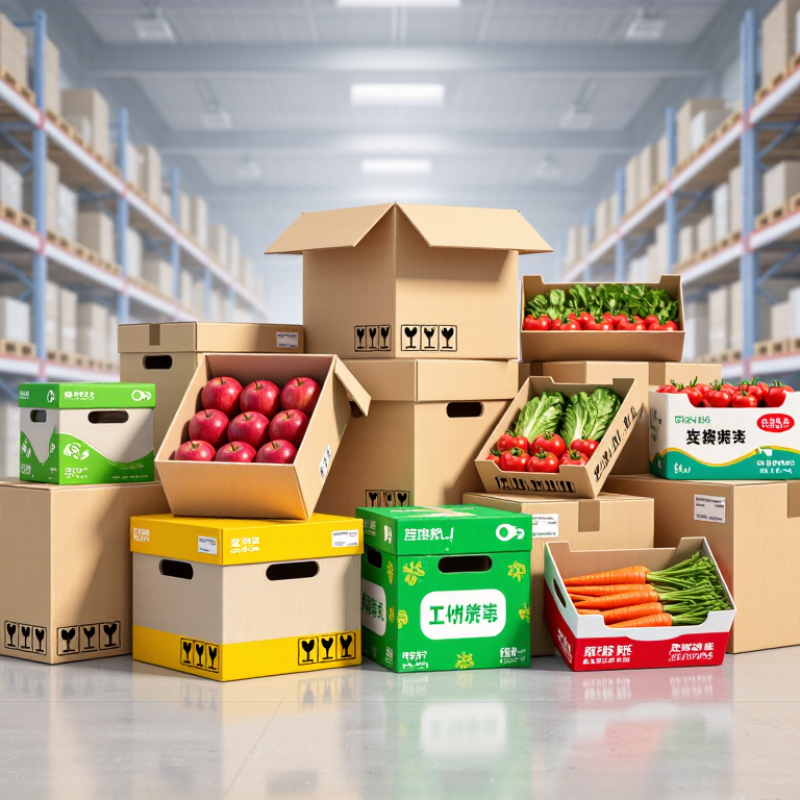
Produce boxes are often defined by their corrugated board structure. A 3-ply board, also called single-wall, has two flat liner sheets and one fluted middle layer. The flute provides cushioning and small air spaces. This structure can suit lighter fruits and vegetables, especially for modest stacking and shorter transport. Crop weight, box dimensions, and handling still matter.
A 5-ply board, commonly called double-wall, combines three liners with two fluted layers. The added wall can improve compression resistance and protect heavier loads during longer distribution. Picture crates of apples stacked in a cool room: corner strength and even load distribution matter. Vents matter, too, because produce needs airflow. More board does not automatically mean safer transport.
When comparing produce-box manufacturers in China, match the board structure to the route, not just the product label. Ask about paper weight, flute type, box size, ventilation, and testing in humid conditions. Moisture matters. A 3-ply box may suit carefully packed leafy greens on a short trip, while 5-ply may be excessive. That guideline is not perfect; packing trials can reveal weak corners and crushed edges that specifications miss.
Compare Edge-Crush Performance Using GB/T 6546-2021 Test Criteria
China Top 10 Produce Boxes Manufacturers: Comparing Edge-Crush Performance Under GB/T 6546-2021
For produce boxes, edge-crush resistance helps indicate how well corrugated board may withstand vertical compression during stacking. GB/T 6546-2021 provides a method for measuring this property. It does not set one universal pass score for every box. Buyers comparing manufacturers should request test reports and check that samples use comparable board grades, flute structures, and thicknesses.
Testing details matter. Samples should be prepared and conditioned consistently, then loaded edgewise using the specified procedure. Ask for the reported result and unit, plus the number of samples and any spread in readings. Averages can look reassuring. Variation matters too. A narrow range may offer more confidence than one unusually high result, though it cannot guarantee box performance in every shipment.
Match the test data to real produce-box needs. Wet markets, cold storage, and long transport can expose packaging to different moisture and stacking conditions. ECT alone does not capture all of these factors. It is a useful comparison point, not the whole decision. One imperfect habit is comparing headline figures before checking board construction; that shortcut can make unlike samples seem directly comparable. Requesting consistent, traceable test information makes supplier comparisons more meaningful.
Check Paper Packaging Against China’s GB 4806.8-2022 Food-Contact Standard
China’s produce-box makers should treat food-contact compliance as a design requirement, not a final paperwork check. GB 4806.8-2022 covers paper and board materials and articles intended to contact food. It took effect on June 30, 2023. The standard sets requirements including sensory and physicochemical indicators. A box may look clean. Looks can mislead.
The FAO’s 2023 SDG Progress Report estimates that 13.2% of food is lost after harvest and before retail. Produce boxes help protect delicate fruit, but wet pulp, ink, adhesives, and recycled fibers deserve careful review. Ask manufacturers for material specifications and test records relevant to the box’s intended food, contact conditions, and use. Check that any additives meet applicable requirements, and confirm that test reports match the actual paper grade and production process.
For a practical supplier review, inspect a sample under realistic conditions: place chilled produce inside, check for odor or color transfer, and note how the board handles condensation. These checks do not replace laboratory testing. They can expose gaps early. One detail is easy to miss: a report for one liner or batch may not cover another. Request traceable documentation and clarify how changes in pulp, coatings, or printing are controlled.
Match Box Ventilation and Load Design to Produce and Cold-Chain Needs
China Top 10 Produce Boxes Manufacturers
Match Box Ventilation and Load Design to Produce and Cold-Chain Needs
A produce box is part of the cold chain, not just a shipping container. Vent openings help cold air move around packed goods, but more holes do not always mean faster, safer cooling. Delicate berries, leafy greens, and dense citrus have different airflow and stacking needs. Box design should reflect the crop, pack pattern, pallet layout, and cooling method.
The FAO’s 2019 food-loss report estimated that 13.8% of food was lost between harvest and retail. That figure does not mean packaging alone can prevent losses. It does show why handling details matter. For a trial, measure cooling time at the center of a loaded pallet, not only at its outer edge. Check whether vents line up between boxes, and whether straps or labels block them. Small details count.
Load strength matters too. Wet produce and high humidity can weaken paperboard, while tall stacks place extra pressure on lower boxes. The right balance depends on transport distance and cold-room conditions. Stronger walls may protect a load, yet poorly placed vents can slow airflow. A tidy drawing can still fail in a real truck. Test with the actual produce, pallet, and route, then revise the design when results disagree with expectations.