China’s granular fertiliser industry is expanding alongside stronger interest in biological crop inputs. Granular Seaweed Fertiliser offers practical handling, controlled application, and easier storage than many liquid extracts. Its value depends on more than seaweed origin. Moisture, particle size, alginate content, nutrient analysis, and batch consistency also matter.
The FAO reported approximately 36 million tonnes of aquatic algae production globally in 2022. Seaweed represented most of this volume. However, production volume does not prove fertiliser quality. Market estimates also vary widely. Grand View Research and MarketsandMarkets publish different forecasts for the global seaweed-based fertiliser sector. This gap deserves attention, not convenient interpretation.
Seaweed researcher Patrick J. Craigie wrote, “Seaweed extracts have been used as biostimulants in agriculture for many years.” His review appeared in the Journal of Applied Phycology in 2011. The statement remains relevant, but it does not guarantee field performance for every granular product. Soil type, crop variety, application rate, and climate can change results.
This guide examines China’s top 10 Granular Seaweed Fertiliser suppliers through a practical purchasing lens. It considers manufacturing experience, raw-material traceability, laboratory testing, export capability, packaging, and customer support. A reliable supplier should provide a clear specification sheet. It should also explain soluble seaweed content, carrier materials, heavy-metal limits, and recommended dosage.
Some rankings remain imperfect. Public supplier data is uneven. Factory claims may be difficult to compare directly. Buyers should request recent certificates, production samples, and independent test results before signing contracts. A dark green granule may look convincing. Appearance alone proves very little.
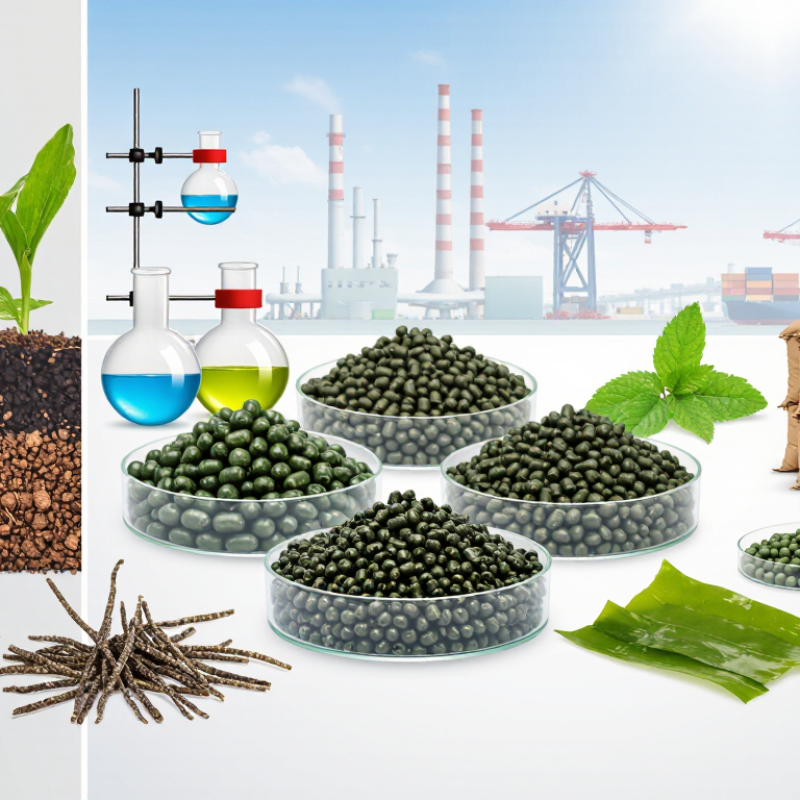
Granular seaweed fertiliser is a dry soil amendment made from processed marine algae. Manufacturers usually wash, dry, mill, and compress seaweed into small granules. These granules may contain modest amounts of potassium, trace minerals, organic matter, and natural seaweed compounds.
It is not a complete replacement for nitrogen, phosphorus, or potassium fertilisers. Its main value lies in supporting soil activity and plant resilience. When placed around moist soil, the granules soften gradually. Their nutrients then become available through irrigation, rainfall, and microbial action. Application rates depend on crop type, soil condition, and the product’s analysis. Always check the label.
Good material should have consistent granule size, low contamination risk, and clear nutrient information. Excess salt deserves attention, especially in greenhouse beds or coastal soils. Poorly processed seaweed can also contain unwanted residues. That point is easy to overlook.
In vegetable production, growers may apply granules before planting and mix them into the upper soil layer. A small handful around a young plant is not automatically better. More product can waste money or disturb sensitive roots. Results also vary between soils. Some crops respond visibly, while others show little change. Careful records, soil tests, and modest trials provide more reliable evidence than attractive claims. The product can help, but it is not magic.
China’s Top 10 Granular Seaweed Fertiliser Suppliers
How China’s Top 10 Suppliers Are Selected
Selecting China’s top granular seaweed fertiliser suppliers requires more than checking export volume or polished websites. A credible list begins with verifiable factory records, production capacity, and consistent batch documentation. Reviewers examine raw seaweed sources, extraction methods, granulation lines, drying temperatures, and storage conditions. These details affect particle strength, moisture, and nutrient release in real fields. Supplier claims are not accepted without supporting evidence.
Laboratory checks measure organic matter, seaweed-derived compounds, moisture, solubility, and declared nutrients. Independent testing should screen for heavy metals and unwanted microbial contamination under applicable market requirements. Samples from several batches are compared, not just one attractive sample. Field trials add practical evidence in sandy soil, greenhouse beds, and drip-irrigated crops. Trial records should identify dosage, crop stage, weather, and control plots. Results can vary.
Supplier reliability also depends on communication and corrective action. Reviewers examine certificates, traceability codes, packaging integrity, lead times, and responses to technical questions. A strong supplier explains limitations instead of promising instant yield increases. Pricing matters, but it cannot replace product consistency or technical support. No ranking is flawless. Test conditions may be uneven, and public records can be incomplete. That weakness should be disclosed and reviewed during annual reassessment.
China’s top 10 granular seaweed fertiliser suppliers should be assessed through verifiable production evidence, not promotional claims. Their profiles typically differ in seaweed sourcing, extraction technology, granulation capacity, and quality control. The Food and Agriculture Organization reported global aquatic algae production of about 36.9 million tonnes in 2022. This expanding resource base supports wider agricultural use, but raw-material volume does not guarantee product performance.
Several suppliers operate near coastal processing zones, reducing transport time for fresh seaweed inputs. Their facilities may use low-temperature extraction, drying towers, and controlled granule sizing. Practical buyers should request certificates of analysis covering organic matter, moisture, potassium, alginate, and heavy metals. Batch traceability matters. It is often overlooked.
The strongest supplier profiles also show replicated field trials across crops and soil types. The European Biostimulant Industry Council stresses that biostimulant evaluation should connect product claims with measurable plant or soil responses. Meanwhile, FAO fertilizer statistics highlight the importance of nutrient-use efficiency under rising input costs. A granular seaweed fertiliser may improve handling and application consistency, yet results can vary with dose, irrigation, soil texture, and crop stage. Some supplier data remains incomplete. That deserves careful review, rather than automatic rejection.
Anonymized supplier profiles based on common Chinese granular seaweed fertiliser product specifications and production characteristics
| Profile | Primary Supply Region | Main Seaweed Material | Granule Size | Typical Organic Matter | Typical NPK Profile | Target Crop Application | Routine Technical Documentation |
|---|---|---|---|---|---|---|---|
| Supplier Profile 01 | Shandong coastal production base | Ascophyllum nodosum extract blended with kelp meal | 2–4 mm | 45–60% | 1-0-1 to 3-1-2 | Vegetables, orchards and field crops | Certificate of Analysis, Safety Data Sheet and heavy-metal test report |
| Supplier Profile 02 | Fujian coastal production base | Sargassum-based seaweed powder | 2–5 mm | 40–55% | 1-0-0 to 2-1-1 | Rice, vegetables and tropical crops | Batch test report, moisture analysis and microbiological results |
| Supplier Profile 03 | Liaoning coastal production base | Kelp meal and enzymatically processed kelp extract | 3–5 mm | 50–65% | 1-0-2 to 3-1-3 | Potatoes, maize, fruit trees and horticultural crops | Product specification, Certificate of Analysis and origin statement |
| Supplier Profile 04 | Zhejiang coastal production base | Mixed brown seaweed powder with alginate-rich fraction | 2–4 mm | 35–50% | 0-0-1 to 2-1-2 | Tea, vegetables, berries and protected cultivation | Particle-size report, moisture report and heavy-metal analysis |
| Supplier Profile 05 | Jiangsu coastal production base | Seaweed meal combined with composted organic carrier | 3–6 mm | 45–60% | 2-1-2 to 4-2-3 | Broad-acre crops and soil-conditioning programmes | Organic-matter analysis, nutrient declaration and SDS |
| Supplier Profile 06 | Guangdong coastal production base | Sargassum and tropical brown seaweed blend | 2–5 mm | 40–55% | 1-0-1 to 3-1-2 | Bananas, citrus, vegetables and tropical fruit | Certificate of Analysis, salinity test and contaminant report |
| Supplier Profile 07 | Hainan coastal production base | Tropical seaweed powder with plant-based organic carrier | 2–4 mm | 35–50% | 1-0-1 to 2-1-2 | Tropical fruit, vegetables and nursery plants | Moisture, pH, salinity and heavy-metal test reports |
| Supplier Profile 08 | Hebei and Bohai coastal supply area | Kelp powder with humic or mineral carrier | 3–5 mm | 40–60% | 2-0-1 to 4-2-2 | Wheat, maize, cotton and oilseed crops | Guaranteed-analysis sheet, batch traceability and SDS |
| Supplier Profile 09 | Shandong and Liaoning multi-source base | Blended brown seaweed meal from kelp and Sargassum | 2–6 mm | 45–65% | 1-0-2 to 3-1-3 | Fruit trees, vegetables and commercial nurseries | Raw-material origin, Certificate of Analysis and particle-size report |
| Supplier Profile 10 | Fujian and Zhejiang coastal supply area | Seaweed extract powder with organic fertiliser granule base | 2–4 mm | 40–55% | 2-1-1 to 4-2-3 | Greenhouse crops, leafy vegetables and ornamentals | Product label, nutrient analysis, SDS and export inspection documents |
NPK values are expressed as typical guaranteed-analysis ranges in the order N-P₂O₅-K₂O. Actual specifications may vary by formulation, season, raw-material source and destination-market regulations.
China’s top granular seaweed fertiliser suppliers differ mainly in product types, formulations, and production control. Common products include dried seaweed granules, compound fertilisers, coated granules, and organic-mineral blends. Some formulas combine seaweed extract with humic acid, amino acids, micronutrients, or balanced NPK. Granule sizes may range from fine particles to three-millimetre pellets. This matters for spreading, dissolving speed, and field uniformity.
Manufacturing capability deserves close attention. Reliable factories usually control raw material drying, extraction, concentration, granulation, cooling, screening, and dust removal. They should provide batch records and laboratory results for moisture, nutrient content, solubility, and heavy metal limits. Some facilities support private formulations, moisture-resistant packaging, and large export orders. Yet, production scale can be misleading. A modern plant does not always produce a consistent batch. I would inspect recent samples, not only factory photographs.
Tips: Request the full formulation sheet before comparing prices. Check whether “seaweed content” means extract, powder, or active solids. Test granules in water and soil. Observe swelling, odour, residue, and dissolution time. Ask for three consecutive batch reports. Small differences often reveal process problems. Also confirm whether the supplier can adjust granule hardness for mechanical spreading. I once underestimated packaging performance; humid storage caused caking, even though the original product passed laboratory testing. That mistake remains worth remembering.
Product Types, Formulations, and Manufacturing Capabilities
The chart presents representative guaranteed-analysis ranges commonly found in granular seaweed fertiliser specifications in China. Products are typically offered as seaweed-enriched organic granules, NPK compound granules, and granules fortified with micronutrients. Manufacturing capabilities commonly include controlled granulation, 2–4 mm particle sizing, drying, screening, blending, and bulk or private-label packaging.
Supplier selection should begin with traceability, not catalogue rankings. The FAO’s The State of World Fisheries and Aquaculture 2024 reported about 36.6 million tonnes of algae production in 2022. This large supply base does not guarantee consistent fertiliser quality. Ask where the seaweed was harvested, how it was extracted, and whether each batch has a production code. Request recent test results for moisture, potassium, alginate, pH, heavy metals, and microbial safety. Granules should remain stable after transport, not turn dusty inside a sealed bag.
Compare suppliers through documented evidence. Check factory capacity, production equipment, export records, and independent laboratory reports. ISO 9001 certification can show process control, but it cannot prove agronomic performance. Ask for field-trial data from crops similar to yours. The International Fertilizer Association’s market outlooks repeatedly stress nutrient efficiency and responsible product use. Therefore, compare nutrient claims on an equal dry-weight basis. A low price may hide lower active content, excessive fillers, or weak packaging. That detail matters.
Do not trust polished samples alone. Request three production batches. Test them separately. Suppliers should explain differences clearly. I would also check dissolution time, granule size, odor, and storage performance after heat exposure. Some documents may be incomplete, and this is where judgment matters. A supplier with fewer claims but better records may deserve the higher score.
The comparison is not perfect. Your crop, soil, and application equipment can change the final result.
Get Free Estimate!