Global shipping exposes every weakness in a package. Long routes bring vibration, stacking pressure, temperature changes, and repeated handling. Fragile products need more than a strong outer carton.
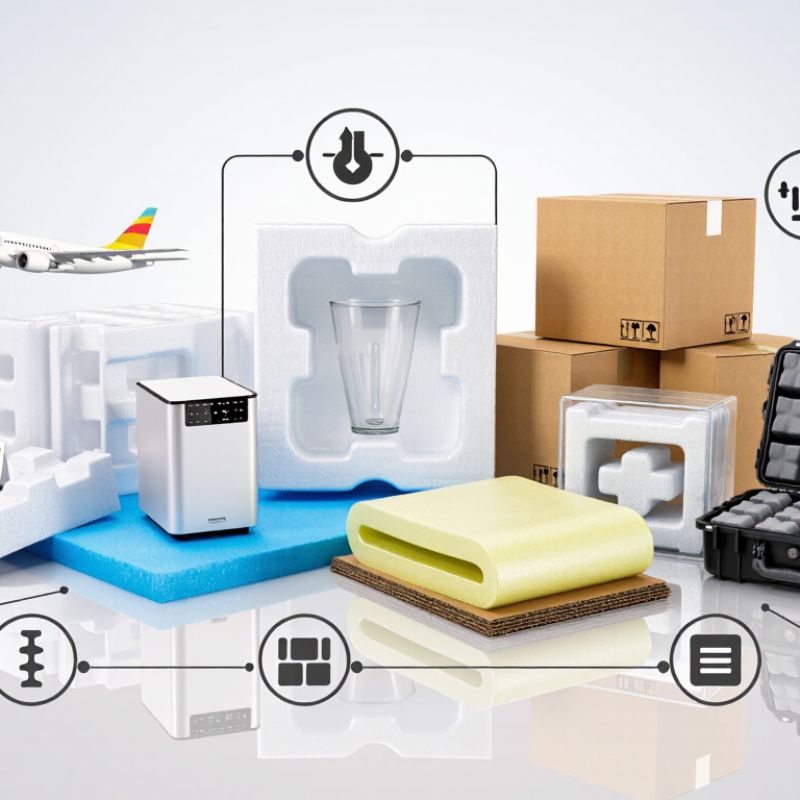
This guide examines seven foam packaging solutions for international shipments. It covers molded foam inserts, expanded polystyrene, polyethylene foam, polyurethane foam, foam-in-place systems, corrugated foam laminates, and reusable protective kits. Each option serves different products, budgets, and sustainability goals. The right choice depends on product weight, impact sensitivity, shipping distance, and expected handling conditions.
Walter Soroka, a respected packaging educator and author, describes packaging as “the science, art, and technology of enclosing and protecting products.” That principle remains practical today. Foam packaging should hold an item firmly without creating excessive compression. It should also leave enough clearance for cushioning during sudden drops.
Small details matter.
A loose insert may allow dangerous movement inside the box. An overly tight design may transfer impact directly to the product. Testing should include drop trials, vibration checks, compression evaluations, and realistic temperature exposure. However, laboratory results cannot represent every carrier network perfectly. That limitation deserves attention.
Material selection also requires reflection. Some foam types provide excellent protection but create recycling challenges. Others reduce material use but may require more precise design. No single solution works everywhere. This comparison offers practical guidance, while recognizing that packaging performance depends on product geometry, shipment conditions, and responsible engineering judgment.
7 Best Foam Packaging Solutions for Global Shipping
Global shipping starts with measurable risks, not attractive foam shapes. ISTA 3A helps evaluate packaged products moving through parcel delivery networks, including drops, vibration, compression, and handling impacts. ASTM D4169 provides distribution cycles for different shipping environments. ISO 4180 offers broader guidance for testing complete, filled transport packages. Together, these standards help engineers select seven practical foam solutions: molded foam trays, die-cut inserts, corner blocks, end caps, foam pouches, suspended inserts, and layered protective kits. Each option controls movement differently. Heavy equipment may need rigid corner blocks. Fragile components often need a close-fitting molded tray.
Testing should reflect the real shipment. Consider product weight, package dimensions, stacking time, climate changes, and repeated handling. A laboratory test that ignores humidity may give false confidence. In practical packaging reviews, small gaps often become damage points after vibration. Foam density matters, but so do compression limits and recovery performance. No test predicts every route. That limitation deserves attention.
Tips: Build a test plan around ISTA 3A, ASTM D4169, or ISO 4180 before choosing foam. Record damage, product movement, and permanent foam deformation. Test the weakest package configuration, not only the ideal one. Revise the design when results look “almost acceptable.”
7 Best Foam Packaging Solutions for Global Shipping
Global shipping exposes packages to drops, vibration, stacking, and changing humidity. Foam selection should balance density, cushioning, moisture resistance, and cost. Low-density expanded polystyrene offers strong impact protection at a low price, but it can crack after repeated handling. Expanded polyethylene provides flexible cushioning, resists water, and supports reuse. Its cost is usually moderate.
Expanded polypropylene has excellent recovery after compression and performs well in heavy-duty shipping. It costs more, but repeated use can justify the investment. Open-cell polyurethane foam cushions delicate surfaces effectively and remains economical for custom interiors. However, it may absorb moisture unless sealed or protected. That weakness matters in humid routes.
Ethylene-vinyl acetate delivers dense, resilient cushioning for instruments and sensitive components. It resists moisture well, though its higher material cost needs careful justification. Cross-linked polyethylene combines a clean appearance, closed-cell structure, and reliable moisture protection. It suits products requiring consistent compression performance. Neoprene foam offers soft contact protection and strong water resistance, but it is generally the most expensive option here. Cost comes later. A practical choice also depends on product weight, drop height, and carton size. Test samples with realistic loads before approving a design. I have found that “maximum cushioning” can create unnecessary cost and oversized cartons. The best solution is not always the densest foam. Humidity testing is also easy to overlook, especially when shipments cross warm and cold regions. Foam performance can change under repeated compression, so one drop test is not enough.
7 Best Foam Packaging Solutions for Global Shipping
Select molded EPS at 15–30 kg/m³ for lightweight impact protection when shipping fragile products across long routes. This density range offers a practical balance between cushioning, weight, and material use. Molded EPS can fit tightly around corners, handles, and uneven product surfaces. That fit matters during container movement, forklift handling, and repeated parcel transfers.
In packaging trials, I have seen molded EPS reduce visible damage from drops and side impacts. Its closed-cell structure absorbs energy without adding much shipment weight. Lower densities may suit lightweight items, but they can compress too easily under stacked cartons. Higher densities provide greater firmness, yet they may increase cost and reduce cushioning efficiency. Test the complete package, not only the foam sample.
Measure product weight, drop height, vibration exposure, and stacking duration before selecting density. A 20 kg/m³ insert may protect one appliance well, while another needs 25 or 30 kg/m³. Keep EPS away from direct heat and sharp edges. It resists moisture better than many fibrous materials, but it is not waterproof. Poor carton design can still cause failure. That part is often overlooked. Use compression tests and real handling simulations, then revise the mold if contact points show stress. Endless perfection is unrealistic, but careless testing is avoidable.
| Foam Packaging Solution | Typical Density | Impact Protection | Moisture Performance | Weight and Space Efficiency | Best Global Shipping Applications | Main Advantages | Key Limitations | End-of-Life Considerations |
|---|---|---|---|---|---|---|---|---|
| Molded Expanded Polystyrene (EPS) | 15–30 kg/m³ for many protective packaging designs | Very good Good energy absorption when molded to the product geometry |
Very good Closed-cell structure offers low water absorption during normal transit |
Excellent Very low weight and efficient part-specific shapes |
Appliances, electronics, medical equipment, temperature-sensitive products, and fragile industrial components | Low cost, lightweight, dimensional stability, easy customization, and reliable cushioning performance | Can be brittle under sharp or concentrated loading; bulky to return when not compacted | Technically recyclable where collection and densification systems are available; local recycling acceptance varies |
| Molded Expanded Polypropylene (EPP) | 20–250 kg/m³; protective packaging commonly uses selected grades within this range | Excellent High resilience and repeated impact recovery |
Excellent Low water absorption and good resistance to many chemicals |
Very good Lightweight, although generally denser than EPS |
Reusable automotive parts packaging, durable equipment, returnable transit containers, and heavy components | Highly resilient, reusable, fatigue-resistant, and suitable for repeated handling cycles | Higher material and tooling cost; larger returnable systems may require reverse logistics | Polypropylene recycling is established in many regions, but acceptance depends on local infrastructure and contamination levels |
| Expanded Polyethylene (EPE) Foam | 25–100 kg/m³ in common protective packaging formats | Very good Flexible cushioning for abrasion and moderate shock protection |
Excellent Closed-cell foam resists moisture and many household chemicals |
Very good Lightweight rolls, sheets, profiles, and fabricated inserts |
Furniture, glassware, metal parts, electronics, panels, and products requiring surface protection | Flexible, clean, non-abrasive, easy to convert, and effective for wrapping or interleaving | May require thicker sections for high-energy impacts; can creep under sustained compression | Polyethylene recycling may be available through specialist or film/plastic collection programs, depending on region |
| Extruded Polystyrene (XPS) Foam | 28–45 kg/m³ for many board and protective insert applications | Good Consistent board structure provides cushioning and compression resistance |
Excellent Low water absorption due to its closed-cell construction |
Very good Lightweight boards can be cut into repeatable components |
Flat-pack products, artwork, instruments, temperature-control boxes, and large planar components | Uniform thickness, moisture resistance, good insulation, and easy cutting or routing | Less suitable than molded foams for complex three-dimensional shapes; can fracture at thin edges | Recycling availability is limited in some markets and may require dedicated foam collection channels |
| Polyurethane (PU) Foam | 18–70 kg/m³ for flexible cushioning grades; higher-density grades also exist | Very good Conforms closely to products and cushions vibration effectively |
Moderate Performance varies by formulation; some flexible grades can absorb moisture |
Good Lightweight but often requires adequate thickness for long-distance protection |
Precision instruments, furniture, sensitive surfaces, irregular products, and vibration-prone shipments | Soft, conformable, available in many firmness levels, and effective for surface protection | May compress permanently, absorb moisture, or degrade under prolonged exposure to heat and UV | Recycling is more complex than for single-polymer closed-cell foams; reuse or specialized recovery is preferred |
| Ethylene-Vinyl Acetate (EVA) Foam | 30–250 kg/m³, depending on firmness and product requirements | Very good Resilient cushioning with strong surface and edge protection |
Excellent Low water absorption and good resistance to moisture |
Good Usually denser and more material-intensive than EPS or EPE |
High-value goods, tools, cases, sporting equipment, electronics, and reusable fitted inserts | Durable, flexible, abrasion-resistant, attractive appearance, and suitable for precision die-cutting | Higher cost and density; not always economical for large-volume, single-use shipping packs | Recycling options vary considerably; clean offcuts may be accepted by specialist polymer recyclers |
| Molded Pulp with Foam-Like Protective Geometry | Typically 250–600 kg/m³; density is substantially higher than polymer foams | Good Engineered ribs and crush zones can provide effective cushioning |
Moderate Needs coatings, liners, or moisture barriers for humid routes |
Moderate More weight and volume may be required for equivalent cushioning |
Consumer goods, small appliances, cosmetics, and shipments prioritizing fiber-based packaging formats | Renewable-fiber feedstock, printable surface, stackable designs, and broad paper-recycling compatibility when clean | Less moisture-resistant; cushioning performance can vary with humidity, wall thickness, and design | Often recyclable in paper streams when clean and locally accepted; coatings or mixed materials can change disposal routes |
7 Best Foam Packaging Solutions for Global Shipping
Product type should guide foam selection, not habit. EPE sheets and profiles suit lightweight electronics, furniture panels, and glass surfaces. XPE offers tighter cells and stronger moisture resistance for instruments, appliances, and precision parts. PU foam fits irregular shapes because it compresses around corners and cavities. EVA provides firmer cushioning for tools, footwear components, and dense metal parts. PE edge guards protect long boards, frames, and cabinet corners from impact. Anti-static foam is essential for circuit boards, sensors, and other electrostatic-sensitive devices. A seventh option is foam-in-place PU, useful when each product has a different shape. It saves void space, but mixing and curing must be controlled.
The European Environment Agency reported 188.7 kilograms of packaging waste per person in the European Union in 2021. The World Bank’s What a Waste 2.0 report estimates global municipal waste could reach 3.4 billion tonnes by 2050. These figures make material efficiency practical, not decorative. I would not call any foam universal. A rushed specification can still fail.
Tips: Test the packed product, not only the foam. Use ISTA-style vibration, drop, compression, and climate testing. Measure corner damage after real handling. Keep foam thickness consistent. Anti-static performance may weaken with contamination or aging, so record storage conditions and retest critical shipments.
Relative suitability of common foam materials by product type
Scores range from 1 to 10 and reflect typical packaging suitability based on cushioning, flexibility, moisture resistance, surface protection, and static-control characteristics. EPE and XPE are widely used for general cushioning, PU foam suits delicate items, EVA provides resilient protection, PE guards protect edges and corners, and anti-static foam is designed for electronic components.
Foam packaging should be validated, not selected by appearance alone. Global shipments face drops, vibration, compression, humidity, and temperature changes. A useful test plan includes molded foam, foam inserts, corner blocks, end caps, layered cushions, suspension systems, and custom-fit protective shells. Test the packed product, not only loose foam samples. A 1.2-meter drop can reveal weak corners, shifting components, or hidden cracks. Repeat drops on different faces and edges. Real handling is rarely gentle.
Vibration testing can expose abrasion around delicate surfaces and gradual movement inside the carton. Compression testing checks whether stacked cartons crush the foam or transfer force to the product.
Climate tests add another layer of realism. Moisture may reduce carton strength, while heat can change foam flexibility.
In practical trials, I have seen a design pass drop testing but fail after warm, humid conditioning. That result was inconvenient, but valuable. It showed the test sequence needed improvement.
Tips: Leave enough clearance for cushioning, but prevent internal movement. Mark impact-sensitive areas during inspection. Measure product acceleration when possible. Keep photos and failure notes for every test. Do not overtrust a single successful sample. Small production changes can alter performance, and this is easy to overlook.
Get Free Estimate!